The logo for The Alignment Company

All Operational Problems Have a People Component.

We Solve Both.

You can see what's broken. The harder question is why the usual fixes don't hold.

We work with founders and senior leaders who are done guessing. We've been inside organizations like yours and we know what moves the needle.From getting your operations right to helping your team work better with AI, we make sure the people powering the work don't get left behind.

Our Four Areas of Focus


Most firms pick a lane. We built ours around a different belief: that the problems showing up in your operations, your culture, your team, and your technology are almost never separate problems. They're the same problem wearing different clothes.The four areas below reflect where we do our best work. Each one carries a point of view we've earned through decades of doing the actual work, not just advising on it.

Organizational
Transformation


Every operational problem has a people problem inside it. To win, you have to solve both. Most advisors pick a side. We don't.

AI
Enablement


AI without human judgment is just a faster path to the middle. Nobody wins there. We center your people in the work.

Training & Org. Development


We don't teach in acronyms or systems. We help your team get better at the hardest part, working with each other.

1-on-1 Coaching and Development


The average leader waits 4.2 years for any leadership development. We think that's too long and costly to ignore.

Who We Work With


We work with founders and senior leaders at growing companies, usually 20 to 200 people, who can see the problem clearly but haven't been able to fix it for good.If any of these sound familiar, keep reading.

The Founder Who’s
Still Holding It All Together


You built this business from the ground up. But now the team is growing, and you’re still the go-to for too many things. You want to lead at a higher level but the day-to-day keeps pulling you back in.

The Team That Can’t
Move Without You


You’ve hired smart people, but decisions stall and priorities shift. Meetings feel messy, communication is inconsistent, and you’re starting to wonder if the team is truly aligned or just really good at looking busy.

The Culture That’s
Starting to Fray


You care deeply about how your business runs and how people treat each other. But lately, tension is rising. There’s friction in the leadership team, and you’re seeing signs of burnout, confusion, and disengagement.

The Business That
Needs Systems to Scale


The demand is there—but the structure isn’t. You need better processes, clearer roles, and a team that can execute with confidence so your next phase of growth doesn’t collapse under its own weight.

Why The Alignment Company?


Most consultants work one side of the equation. They fix the system or they work with the people. They rarely do both, and almost never at the same time.We built TAC around a different belief. The operational problem and the people problem are almost never separate. They share a root cause. Fix one without the other and the same problem comes back wearing different clothes.We don't show up with a framework and a slide deck. We sit in the room where the work actually happens. We stay until it holds. And we bring complementary disciplines into every engagement so the diagnosis is complete before the work begins.A few things we believe that most firms shy away from:

  • We don't advise. We sit at the table.

  • We teach human skills, not labels.

  • The work is only done when it runs without us.

Our Work, Their Words

Karen and Brian at the Band Shell on the State Fairgrounds in Saint Paul, MN

"The Workplace Collaboration training with Karen and Brian has had an immediate and meaningful impact on all 90 members of the State Fair team. The feedback was overwhelmingly positive, and the benefits continue to grow as we carry the work forward."Renee Alexander, CEO, Minnesota State Fair


"It was genuinely one of the more useful conversations on the AI topic I've had in a while. The 90/10 framing has stuck with me."Nick Serati, Co-Founder, Thrifty Traveler


We also helped a founder-led business grow revenue by 33% in nine months by building the operational systems needed to scale from one location to multiple sites.That's what solving both sides of the problem looks like.

About Us


Most advisory firms send you an expert. We send you a team that sees your organization from two angles at once, and stays until what we find gets fixed.Karen works with your people. She understands what's driving them, what's holding them back, and what they need to hear to move forward. Brian works on your systems, your structure, and the operational gaps that keep the same problems coming back.We don't hand off findings or file reports. We sit in the same rooms, work toward the same outcomes, and bring a complete picture to every engagement.That's not how most firms work. It's exactly how we do.

Karen Knab, Co-Founder of The Alignment Company

Karen Knab

Executive Coach • Family Business Advisor • LMFT


Karen brings 20 years of experience as a licensed Marriage and Family Therapist and certified executive coach. She works with leaders and teams on the conversations, dynamics, and development that determine whether an organization actually functions the way it's supposed to. Whether she's coaching founders, developing leadership teams, or building the communication skills that power collaboration, she works at the level where lasting change actually happens. Her background in family systems gives her a rare ability to see the relational patterns inside an organization that most advisors never think to look for.

Brian Hanley, Co-Founder of The Alignment Company

Brian Hanley

Business Operations • Strategic Planning • Executive Advisor


Brian spent over 30 years running complex organizations before founding The Alignment Company. He has managed $100M+ budgets, led 500-person workforces, and delivered operational turnarounds across manufacturing and technology environments. His 20+ years leading enterprise technology gives him a grounded, practical perspective on what AI can and can't do for a growing business. He holds a Master's in Conflict Resolution. He knows what it takes to build systems that scale and has learned, from experience, that the systems only hold when the people inside them are aligned.

Thank You for Subscribing!


You're in. Every other week you'll get a short, useful perspective on the people and operational challenges that slow growing businesses down. No frameworks. No jargon. Just clear thinking you can use.While you're here, here's something useful.One of the most consistent things we see in growing organizations is conflict that goes unaddressed — not because people don't care, but because they don't have a shared language for what's actually happening.This guide gives you that language.Download: The Six Types of Workplace Conflict - A practical guide to recognizing conflict early and knowing where to start.

Stay in the Loop


Every other week we share a short, useful perspective on the people and operational challenges that slow growing businesses down. No frameworks. No jargon. Just clear thinking from people who've been inside organizations like yours.When you subscribe you'll also receive our guide to the six types of workplace conflict. This practical tool will help you recognize what's actually happening in your organization and know where to start to turn things around.

Join Our Newsletter

The 90/10 AI Accelerator

A 3-Session Training Program to Maximize the Impact of AI for Your Organization


AI is not going to replace your team. But someone who knows how to use it well is going to outperform someone who doesn't.Here's what most AI training gets wrong: they sell it as less work. It isn't. AI is different work. The volume work gets faster. The judgment work gets harder. Most organizations haven't designed around that reality yet.

"You can now be consistently mediocre at extraordinary speed. Or you can amplify everything that is distinctly, recognizably yours."

- Brian Hanley, Co-Founder, The Alignment Company

The Scale Has Changed.
Lake Harriet was the Internet. This is Lake Superior.


An image showing Lake Harriet, a small lake in suburban Minneapolis, superimposed on Lake Superior illustrating the change in scale between wha the internet represented and the potential of AI.

The 90/10 Framework


AI Generates. You Govern.AI handles 90% of the work; the drafting, the synthesis, the structure. The final 10%; the judgment, the standards, the meaning, has to come from you.Mastery isn't about doing less. It's about knowing exactly where your expertise has to show up.

"AI is a tool to think with, not a tool to think for you."

- Ethan Mollick, Wharton Professor

What We See in Most Organizations


The Train has Left the Station

AI tools are being adopted faster than the skills to use them well. Your team is already using AI. The question is whether they're using it in a way that reflects your standards or someone else's defaults.

Racing to the Middle

A generic AI reflects the average of the entire internet. Your competitive advantage is that you are not average. We help you build the habits and systems that make sure your work stays distinctly, recognizably yours.

The Program


Leading AI Intentionally

For Architects and Leaders

Governance, organizational design, and the three questions every leader must answer before AI scales inside your organization. This is where intentional adoption begins.

Beyond the Bot

For Practitioners

Clear the fog. Your team learns why there is no one-size-fits-all AI solution, how to build a personal AI stack, and what the 90/10 framework means for how they work every day.

The Skillset Lab

In-Person, Hands on Keyboards

Your team masters Context-Priming, fact-checking, and synthesis at scale. No theory. Everyone leaves with a prompt library built around their actual daily work.

What Makes This Different?


We teach judgment, not just tools.

There is no shortage of courses on AI. There is a shortage of programs that help your people understand where they are essential, and build the habits to do it consistently.

We keep your people at the center.

AI without human judgment is just a faster path to the middle. We make sure the people powering the work don't get left behind as the tools change around them.

We've run actual organizations.

We know what good output looks like because we've been accountable for it. That's not something most AI trainers can say.

Book a Conversation

A conversation costs nothing. Most people leave it with more clarity than they came in with. Share a little about what's on your mind and we'll show up ready to dig in, not just introduce ourselves.

FAQ


Does our leadership team need to participate for the practitioner sessions to work?

Not required, but the results are significantly more durable when leadership has aligned on governance and expectations first. That's exactly what the Executive Briefing is designed to do.


Is this only for tech-savvy teams?

No. The program is built for professionals who use standard workplace tools and want to use them with more intention and skill. No technical background required.


How long does the full program take?

Three sessions over a flexible timeline. The Executive Briefing can be delivered before or alongside the practitioner sessions depending on your organization's needs.


Can individual sessions be delivered separately?

Yes, and we'll help you figure out the right starting point in our first conversation.

1-on-1 Coaching and Development

Direct, Honest and Tailored to the Individual


Karen Knab is an executive coach and licensed therapist with over two decades of experience helping leaders and teams in founder-led and family-owned businesses navigate the critical conversations and relational dynamics that determine whether their businesses thrive or fracture.

Services Offered


"The Conversation You've Been Avoiding"

Executive Coaching for Difficult Conversations

Most leaders don't lack the words. They lack the confidence that the conversation won't make things worse. This coaching is for the leader who knows what needs to be said but keeps finding reasons to wait. Ironically, the longer you wait the harder things get.Through focused 1:1 work, Karen helps you build the clarity, composure, and communication skills to handle high-stakes conversations with honesty and care. The goal isn't one better conversation. It's a fundamentally different relationship with the ones that matter most.

"Nobody Taught You This"

New Leader Transition Coaching

You were promoted because you were exceptional at your work. Nobody told you that leading people is an entirely different skill set.This coaching meets new leaders exactly where they are, navigating authority, building trust, giving feedback, and making decisions that affect real people. Karen brings decades of experience working with leaders at this exact inflection point. The transition from individual contributor to trusted leader doesn't have to be as isolating as most people make it.

Outcomes


You will leave better prepared for the conversation in front of you. More importantly, you will leave permanently better equipped for every difficult conversation that follows.Most people walk away from coaching with better words. Karen's clients walk away with better instincts. You will develop the self-awareness to recognize what is actually happening in a high-stakes moment, the composure to stay present when it gets uncomfortable, and the language to say the hard thing without damaging the relationship.The skills Karen teaches are rooted in how people actually work, not how organizations wish they would. That means they don't stay at the office. Clients consistently find that what changes at work changes everywhere, in their families, their friendships, and the relationships that matter most to them.The conversations don't get easier. You get more comfortable in them. There is a significant difference.

About Me


Profile picture of Karen Knab

Experience

I bring over 10,000 hours spent with individuals and groups, where I’ve gained the unique ability to quickly understand when situations are out of alignment, what options are available, and how to navigate to the best outcome for all parties.

My Coaching Style

My approach blends the candor of my East Coast roots with the respect and tact of my Midwest influence. I help leaders identify the real issues they face by providing honest, compassionate feedback to reach effective solutions. Working with me means engaging in direct, one-on-one sessions tailored to your specific situation. This is not a cookie-cutter framework or a theoretical exercise; it is a skilled coach sitting across from you, using a diverse toolkit to help you build the emotional regulation, communication skills, and boundary-setting capabilities needed to handle hard conversations with confidence.

  • Flexible and Co-Creative: We collaborate to create an experience that works for you. After defining your objectives and key results, we continuously review your progress and adjust our process as needed, with no fixed time commitments.

  • Comprehensive: Professional growth often yields benefits in your personal life. Clients frequently report reduced stress and anxiety, improved sleep, enhanced mood, and a decreased dependence on unhealthy habits or behaviors, alongside increased motivation to adopt healthier ones.

  • Results-Oriented: We regularly track progress toward your goals. Because coaching is ultimately about transformation—doing less of what holds you back and more of what moves you forward—I adapt my style to help you overcome specific barriers.

Influences

Sharing the importance of emotional intelligence and healthy team dynamics is a passion of mine. I have delivered numerous workshops and lectures on topics such as communication, boundary-setting, and relationship-building. My practice draws on insights from diverse thought leaders in both psychology and business, including Patrick Lencioni, Simon Sinek, Adam Grant, Dr. Sue Johnson, Bert Hellinger, Dr. Gabor Maté, and Dr. Bessel van der Kolk.

Techniques

My approach is holistic, integrating best practices from Systems Theory, Emotional Intelligence, Developmental Psychology, Mindfulness Techniques, Internal Family Systems (IFS), Attachment Theory, Restorative Justice Talking Circles, Twelve-Step Philosophy, and Family Constellations to address your unique needs.

My Background

I have lived and worked in various cities throughout my career, including Minneapolis, MN; Austin, TX; Los Angeles and Orange County, CA; Buffalo, NY; and Washington, D.C. For more information about my professional background, please view my LinkedIn profile.

Ready to Take a Step?

The first conversation is just that. A conversation. No pressure, no pitch. Just an honest discussion about where you are, where you want to be, and whether working together makes sense.

Organizational Transformation

When the Business Outgrows How It's Been Run


Every founder reaches this point. The thing that made you successful is now the thing getting in the way. Your team is bigger but decisions are slower. You have more people but less clarity. The systems that worked at ten people don't work at thirty.This is not a failure of leadership. It is a signal that the organization needs to evolve. That's exactly the work we do.

What We See


Strategy That Never Sticks


The goals exist. The priorities keep shifting. Teams stay busy but traction is elusive. The plan never quite connects to the work.

Teams That Don’t Move as One


Decisions don't hold. The same topics resurface without resolution. You're not sure if the team is truly aligned or just really good at looking busy.

Silence Instead of Debate


Conflict goes unaddressed. Leaders don't speak up. Tension simmers until something breaks, and even then nobody wants to name it.

Leadership Bottlenecks


Too many decisions still come to you. You want to delegate but when you do things fall through. Without the right structure, it's easier to just handle it yourself.

"The gap between strategy and execution is almost always a people problem wearing an operational mask."

How We Work


An illustration showing the flow of Plan, Align, Execute.

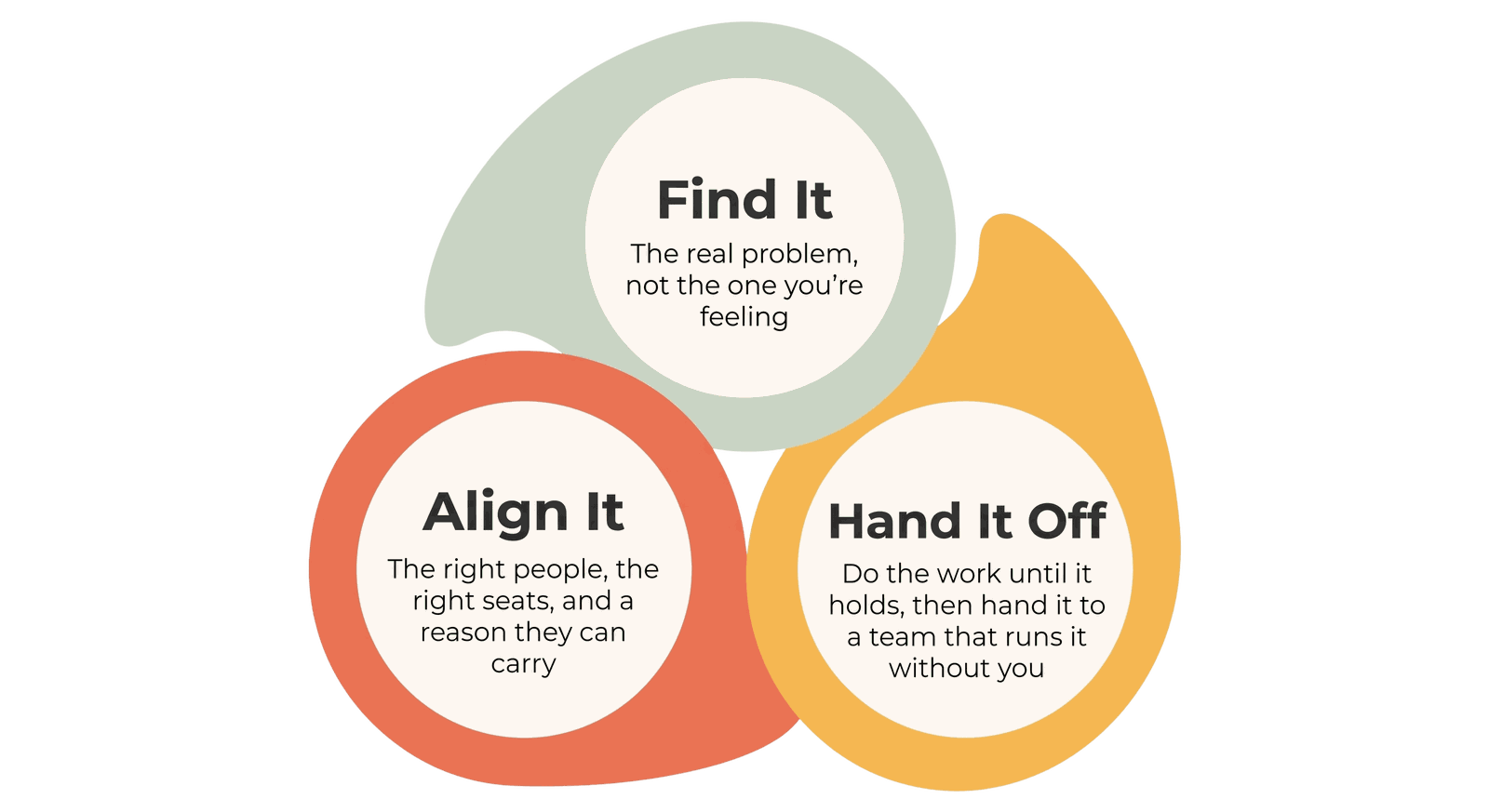
We don't show up with a framework and a slide deck. We start by understanding your business from the inside; how decisions get made, where trust exists, where it doesn't, and what's actually getting in the way.Every Organizational Transformation engagement begins with a structured diagnostic. It's the foundation everything else is built on. We won't recommend a path forward until we understand what's actually driving the problem.From there the work is embedded and hands-on. We sit in the rooms where the real work happens. We stay until what we build runs without us.

"One of our clients grew revenue by 33% in nine months. The breakthrough wasn't a new idea. It was building the operational foundation their growth had been waiting for."

Does This Feel Like the Right Conversation for You and Your Business?

If your organization is growing but something isn't keeping pace, let's talk. The first conversation is about understanding where you are. Nothing more.

FAQ

How long does an engagement usually last?

Most Organizational Transformation engagements run six to twelve months. The diagnostic at the start informs the scope and timeline.


What does the diagnostic process involve?

A structured assessment of your operations, leadership dynamics, and organizational health. It's designed to surface the real issues, not just the symptoms.


Do we need to commit to a full engagement upfront?

No. The diagnostic is the starting point. It gives both of us the information needed to decide whether a deeper engagement makes sense and what it should look like. Either way you are left with a clear perspective on the state of your business and a plan you can execute with or without us.


How is this different from a typical management consultant?

We don't hand off a report and leave. We stay embedded in the work until the systems hold and the team can run without us.

Training & Organizational Development

Real Human Skills That Carry Forward Into the Work


Most training events feel good in the room and disappear by Monday. We build programs that change how your team actually works together, not just how they talk about it.

Mastering Workplace Collaboration

Our Flagship Program


Stop "The Meeting After the Meeting" from draining your team's momentum.

Every team has them. The real conversations that happen in the hallway after the meeting ends. The decisions that get relitigated in side channels. The friction that never gets addressed directly because nobody knows how to start that conversation.This is where trust erodes. This is where momentum dies. And this is exactly what Mastering Workplace Collaboration is designed to fix.

"The Workplace Collaboration training with Karen and Brian has had an immediate and meaningful impact on all 90 members of the State Fair team. The feedback was overwhelmingly positive, and the benefits continue to grow as we carry the work forward."Renee Alexander, CEO, Minnesota State Fair

Want the Full Picture?


Download the Mastering Workplace Collaboration one-sheet for a complete overview of the program, sessions, and outcomes.

The Program


Icon highlighting an active listening course listing.

Active Listening

Session One

We teach you to listen to understand, not just respond. Most workplace friction starts with assumptions. This session eliminates the most costly ones.

Icon highlighting an effective communication course listing.

Effective Communication

Session Two

Shifting from listening, learn to deliver feedback clearly and respectfully, even in difficult conversations. Direct doesn't have to mean damaging.

Icon highlighting a course listening covering how teams can work together effectively through shared agreements.

Rules of Engagement

Session Three

We implement a shared roadmap for addressing friction and moving forward productively. Your team leaves with a framework they can use immediately.

"We help your team do the hard work of working together"

The Results


KPI Icon- accent image

25% Lower Staff Turnover

Teams with high psychological safety and strong conflict skills stay longer.

Source: Gallup

KPI Icon- accent image

18% Faster Project Completion

Organizations that prioritize effective communication meet milestones sooner.

Source: PMI

KPI Icon- accent image

50% Reduction in Conflict Costs

Structured conflict training significantly reduces the time and expense of formal grievances.

Source: NIH

Additional Programs


Rules of Engagement


Guides teams in defining shared expectations for how they communicate and collaborate. This session builds the foundation for durable trust by helping participants establish norms that make discussion, disagreement, and decision-making more productive.

Training Delivered as a Single, Half-Day Workshop

Running Better Meetings


Take meetings from performative to productive. Turns meetings into a true engine for progress. Teams learn how to set clear objectives, clarify roles, and create space for focused discussion and follow-through; transforming how work gets done day to day.

Training Delivered as a Single, 2-Hour Session

Ready to End the Meeting After the Meeting?

If your team is having the meetings after the meetings, that's the signal. Let's talk about what's getting in the way and whether we're the right fit.

FAQ

How is this different from other communication or conflict training?

We don't teach frameworks or hand out personality labels. We teach the human skills that make collaboration possible and build them through practice, not theory.


Can this be delivered for our leadership team only?

Yes. The program can be scoped for a leadership cohort, a full team, or a cross-functional group depending on where the friction is showing up


Do you offer one-off sessions?

The Mastering Workplace Collaboration series is designed as three connected sessions because lasting change requires repetition and practice. Single sessions are available for the additional programs.


Can you customize the content for our industry or culture?

Yes. Every program is adapted to reflect your organization's specific dynamics, language, and goals.